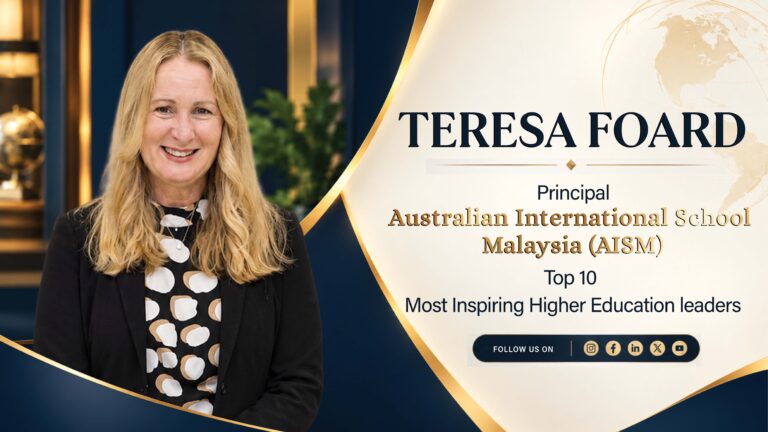
In an educational landscape shaped by rapid technological change, artificial intelligence and an increasingly interconnected world, schools are being challenged to prepare students for careers and opportunities that may not yet exist.
For Australian International School Malaysia (AISM), the answer begins with something fundamental: developing young people who know how to think, communicate, collaborate and approach challenges with confidence.
As an Australian international school in Malaysia, AISM brings together the strengths of the Australian Curriculum, the NSW Higher School Certificate pathway and a diverse international community. But its educational philosophy extends beyond academic achievement.
The school’s vision is centred on developing students who are curious, capable and grounded young people who can pursue ambitious goals while remaining thoughtful about their responsibilities to others and the wider world.
At the heart of this approach is a belief that education should prepare students not simply for their next examination, but for the independence, adaptability and resilience they will need throughout their lives.
For AISM, becoming future-ready starts in the classroom.
Students are encouraged to become active participants in their learning rather than simply receiving information. Teachers establish clear learning intentions, provide meaningful feedback and encourage students to reflect on their progress.
This creates an environment in which students understand where they are in their learning, where they need to go next and what they can do to improve.
The Australian Curriculum provides a strong foundation for this approach, allowing learning to be connected with inquiry, problem-solving and real-world contexts.
But the learning experience does not end when the classroom lesson finishes.
Sport, performing and visual arts, leadership, service and co-curricular activities provide students with additional opportunities to discover their interests, develop strengths and build confidence.
For AISM, this is an important part of what it means to educate the whole child.
Confidence, after all, does not come simply from knowing the right answer. It develops when students feel safe enough to ask questions, make mistakes, receive feedback and try again.
One of the defining elements of the AISM learning experience is its focus on Visible Learning.The approach encourages teachers and students to concentrate on the practices that have the greatest impact on student progress.
In practical terms, this means students are not left wondering what they are learning or what successful learning looks like.Learning intentions and success criteria are made clear, while feedback helps students understand their progress and identify their next steps.
This has an important effect on student ownership.As students become more aware of themselves as learners, they are increasingly able to reflect on their strengths, recognise areas for improvement and use feedback constructively.
Visible Learning also encourages teachers to continually examine their own impact. Assessment data and evidence are used not simply to measure achievement, but to identify what is working, where students require additional support and where further challenge may be appropriate.
The impact can be seen in AISM’s academic performance. Across Foundation to Year 10, combined student performance is above Australian norms in Reading and Mathematics on the Progressive Achievement Test (PAT). Yet the significance of Visible Learning goes beyond academic data.
AISM sees students becoming more reflective, more comfortable seeking feedback and increasingly capable of articulating what they are learning and how they can improve. These are habits that can support independent and lifelong learning.
At AISM, leadership is not defined simply by a badge, title or formal position.
Leadership begins much earlier through everyday opportunities for students to make choices, contribute ideas, take responsibility and support others.
As students move through the school, those opportunities become increasingly structured.
They may take responsibility within the classroom, represent their peers, contribute to school events, participate in community initiatives, mentor younger students or assume formal student leadership positions.
Importantly, AISM recognises that leadership can take many forms.
Some students may lead through confident public speaking. Others may demonstrate leadership through empathy, creativity, reliability, organisation or an ability to bring people together.
The objective is not to create one model of a leader, but to help students recognise and develop their own strengths.
Students also need opportunities to practise leadership in authentic settings.
Student leaders at AISM, for example, contribute to welcoming families and representing the school community. Such responsibilities require students to communicate with adults and younger students, listen carefully and respond with confidence.
By Year 12, the aim is for students to understand that leadership is ultimately about responsibility, contribution and the positive influence they can have on those around them.
AISM’s more than 50 co-curricular activities provide another important dimension of the school’s educational experience.
Spanning sport, the arts, academics and community initiatives, these opportunities allow students to explore interests and discover strengths that may not emerge during a conventional lesson.
A student may discover confidence on stage, perseverance through sport, creativity through the arts or a sense of responsibility through service and leadership.
These experiences also develop qualities that are difficult to teach through textbooks alone.
Being part of a team requires communication, resilience and the ability to respond to both success and disappointment. Performing before an audience develops courage. Preparing for competition teaches commitment and discipline. Community initiatives help students understand that their actions can have an impact beyond themselves.
Co-curricular activities also strengthen relationships across the school community, allowing students to build friendships across year groups and interact with teachers in different environments.
For AISM, academic achievement remains important but education should also give young people space to discover who they are.
AISM’s educational pathway follows the Australian Curriculum before students progress to the New South Wales Higher School Certificate in Years 11 and 12.
The HSC provides graduates with pathways to universities in Australia and around the world, while its combination of school-based assessment and external examinations encourages students to demonstrate their understanding in different ways.
However, university preparation at AISM goes beyond academic qualifications.
Personalised careers and pathways guidance helps students understand their strengths, explore different fields and make informed decisions about subjects, university options and future careers.
This is increasingly important in a world where young people may study in one country, work in another and collaborate with colleagues across multiple cultures.
Students therefore need more than academic knowledge.
They need independence, adaptability, communication skills and the confidence to navigate unfamiliar environments.
That combination is central to the educational experience AISM aims to provide.
AISM’s strong HSC performance reflects a philosophy that academic success is developed over many years rather than created in a student’s final year of school.
The school’s Class of 2025 recorded a 100% HSC pass rate, with 17 Distinguished Achievers, while overall results placed the school within the top 10% in NSW. In addition, 47% of students achieved an ATAR of 80 or above.
These outcomes are significant, but AISM sees them as the result of a much broader process.
Teachers knowing their students well allows the school to respond to individual needs whether that means providing greater academic challenge, targeted support or guidance in developing effective study strategies.
Visible Learning strengthens this foundation by helping students understand what success looks like, use feedback constructively and take increasing responsibility for their own progress.
In Years 11 and 12, these habits are supported by experienced subject teachers, academic monitoring and personalised careers and pathways guidance.
The HSC structure itself encourages sustained engagement through its combination of school-based assessment and external examinations.
Ultimately, AISM views strong results as a partnership between students, teachers and families.
The grades matter but so do the discipline, resilience and independence students develop along the way.
Few forces are changing education as rapidly as artificial intelligence.
For AISM, the response is not simply to restrict technology, but to teach students how to engage with it critically and responsibly.
Students need to understand both the capabilities and limitations of AI, including issues such as hidden bias, hallucinated citations and the growing problem of low-quality AI-generated content, sometimes described as “AI slop”.
The challenge for educators is to ensure that technology supports learning without replacing the human thinking at its centre.
AISM’s approach places academic rigour alongside critical awareness.
The teacher’s role remains essential in ensuring that students develop their own perspectives, question information, evaluate evidence and maintain intellectual independence.
In this environment, technology becomes a tool rather than a substitute for thought.
The skills that matter most may therefore be increasingly human ones: curiosity, judgement, creativity, communication, collaboration and the ability to think critically.
As AISM looks to the future, student voice is becoming an increasingly important part of its vision.
Young people develop leadership when adults trust them with meaningful responsibility, listen to their perspectives and provide opportunities for them to contribute.
This philosophy reflects a broader understanding of education.
Students should not simply be recipients of a school experience. They should have a role in shaping their community and learning to take responsibility for the choices they make.
Creating these opportunities helps students develop confidence while also teaching them that leadership is connected to listening, accountability and contribution.
Looking ahead, AISM’s ambition is to continue building a school where students are known, challenged and encouraged to become the best version of themselves.
Academic excellence will remain an important priority, but the school’s responsibility extends beyond examination results and university entry.
AISM wants its graduates to be confident in their abilities, curious about the world and comfortable working with people from different cultures and perspectives.
They should be able to think critically, communicate with purpose and make thoughtful decisions even when the path ahead is uncertain.
As an Australian international school in Malaysia, AISM has an opportunity to combine an Australian educational foundation with the perspectives and experiences of a diverse international community.
The school will continue to strengthen this experience through excellent teaching, meaningful student leadership, wider learning opportunities and strong connections across its community.
For AISM, global leadership is not defined by a title.
It is about character, responsibility and the ability to make a positive contribution.
Ultimately, the measure of a school extends beyond examination results.
AISM’s aspiration is for graduates to leave with the confidence to pursue their ambitions, the humility to continue learning and the willingness to contribute positively wherever their next chapter takes them.
The goal is to develop young people who are curious without losing their grounding, ambitious without losing their sense of responsibility, and confident without losing their willingness to listen.
In a rapidly changing world, no school can predict exactly what the future will look like.
What it can do is prepare young people to face that future.
For AISM, that means giving students the knowledge to succeed, the skills to adapt and the character to make a meaningful difference.
The future may be difficult to predict but AISM is focused on ensuring its students are ready to shape it.
Entrepreneurship is all about telling your story. In SwiftNlift Education Business magazine, we promote and share stories and adventures of young and successful entrepreneurs who are overcoming startup challenges on their way to success. We allow digitally linked content to be uploaded and distributed globally.
Copyright © 2023 Swiftnlift Media And Tech LLP All rights reserved